A finished-order checklist is useful only when each checkpoint connects to a buyer requirement and a repeatable decision rule. Generic lists may miss critical functions or add irrelevant checks, while vague limits invite disputes after inspection. Define the product version, lot, methods, samples, defect classes, and disposition before goods are presented.
Key takeaways
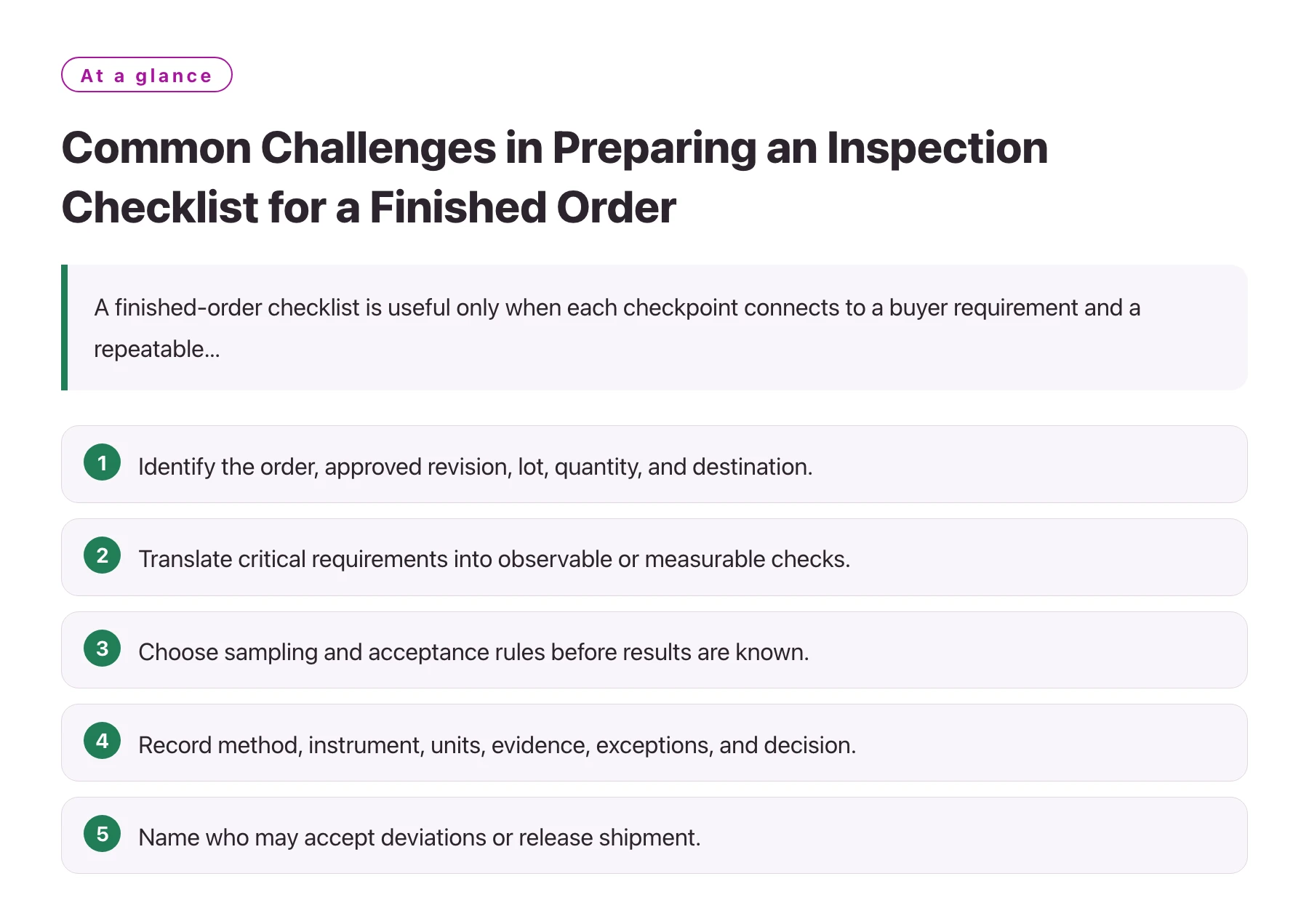
- Identify the order, approved revision, lot, quantity, and destination.
- Translate critical requirements into observable or measurable checks.
- Choose sampling and acceptance rules before results are known.
- Record method, instrument, units, evidence, exceptions, and decision.
- Name who may accept deviations or release shipment.
A checklist turns requirements into repeatable observations and supports a decision within a clearly stated scope.
1. Identify the order and inspection lot
Put order number, supplier, factory, product, model, revision, destination, quantity, cartons, production dates, and presentation status at the top of the checklist. Define which units form the lot and whether variants, colors, or production periods must be separated.
Confirm the order is complete enough for the planned inspection. Record what is packed, unpacked, unavailable, or still in production. A checklist applied to mixed or unidentified goods cannot support a reliable lot decision.
2. Translate requirements into checkpoints
Use the approved specification, drawings, sample, packaging instructions, labels, and purchase order. For each requirement, state the characteristic, method, sample, limit, unit, and evidence to record. Avoid checklist items such as “good quality,” “normal appearance,” or “works well” without an agreed definition.
Separate safety, regulatory, essential function, fit, appearance, packaging, and documentation checks. Rank severity and define what happens if a critical defect is found. Ensure each item is relevant to the product and destination.
3. Select sampling and acceptance rules
Define lot size, inspection level, sample selection, sampling plan, acceptance or rejection number, and handling of re-presented lots in advance. ISO 2859-1:2026 provides AQL-indexed sampling schemes for lot-by-lot inspection by attributes; apply the current edition and contractually agreed plan, and do not treat AQL as a target defect allowance. [1]
Sampling does not guarantee that every unit is conforming. Critical safety or regulatory features may require a separate 100 percent check or other control. Have the quality owner select an appropriate plan based on product risk, history, and contract rather than choosing a convenient table after seeing results.
4. Define functional and measurement methods
For dimensions, identify datum, measurement point, instrument, resolution, calibration, and tolerance. For function, specify setup, duration, cycles, operating conditions, expected result, and safety precautions. For visual review, name lighting, distance, reference sample, and accepted variation.
Check that equipment is suitable and results are recorded consistently. If test conditions differ from intended use, note the limitation. Destructive checks, powered testing, or chemical exposure may require specialists and separate authorization.
5. Include quantity, workmanship, and packaging
Verify finished quantity, model mix, accessories, assembly, workmanship, labels, carton marks, pack list, and protective materials against the order. Record carton sampling and whether inspection included inner packing. Check that serial, batch, or lot codes can be read and traced.
For shipping risk, assess carton strength, moisture protection, corner protection, cushioning, pallet stability, and container loading evidence where applicable. Do not assume product checks cover packaging or logistics requirements; include each obligation explicitly.
6. Make the checklist usable in the field
Use one row per decision with clear response fields for result, measurement, defect code, photo, and notes. Include instructions for not applicable, pending, inaccessible, and failed checks. Make room for lot and sample identification, report author, date, location, and equipment used.
Use controlled versions and remove obsolete criteria. Provide language or diagrams where necessary, but keep the underlying requirement unambiguous. Test the checklist on a sample unit before the formal inspection to find confusing terms or missing equipment.
7. Control nonconformance and retesting
Define containment, segregation, corrective action, rework, concession, reinspection, and buyer escalation. A failed check should identify affected units and evidence rather than rely on a verbal assurance. State which person may accept a deviation and whether the shipment must remain on hold.
Record rework scope and whether repeated checks need a new sample. Keep original results and follow-up results linked so the history is auditable. Do not erase a failure after correction; preserve both findings and disposition.
8. Separate inspection result from shipment authorization
A report documents sampled evidence within its stated scope. The buyer’s named release authority should verify that all critical checks, open documents, approvals, and commercial conditions are complete. If the inspector lacked access to a requirement, mark it as not checked and assign follow-up.
Set a release matrix for pass, fail, conditional acceptance, and pending evidence. Identify how supplier and buyer are notified and who may authorize shipment. This prevents a summary label from obscuring unresolved high-risk items.
9. Review and improve after each order
After delivery, compare inspection findings with receiving claims, field failures, and customer feedback. Remove irrelevant checks, add effective controls, and review sampling strategy when defect history or risk changes. Keep updates under revision control and share them before the next inspection.
Buyers arranging finished-goods inspection before shipment can provide the checklist with product version, sample rules, access, report deadline, and escalation contacts. This lets the inspection team gather evidence for the buyer’s actual release decision.
Sources
Frequently asked questions
What should a finished-goods checklist contain?
Include order and lot identity, approved requirements, methods, limits, sample plan, packaging, documents, result fields, and release authority.
Does an AQL plan mean the buyer accepts that many defects?
No. AQL is part of a sampling scheme, not a guaranteed defect rate or a substitute for contract limits and risk review.
Can a final inspection replace process control?
No. It samples finished goods at one point and cannot prevent every defect or verify all hidden process risks.
Who approves shipment after inspection?
A buyer-named release authority should review results, open findings, required documents, and any approved deviations.