Keeping Personal Data Out of Chat Logs
Every conversation builds a record of what you typed, and the most effective protection is not a setting but a habit formed before you type. If an identifying detail never enters a session, there is nothing in the log to find later, and that is the only deletion a reader fully controls.

Key takeaways
- A chat log holds what you write, what the character returns, and the saves and preferences that build up around them.
- The rule that does the most work: no real names, employers, addresses, contact handles or financial detail.
- Prevention beats clean-up. Detail that was never typed cannot be exposed by an export, a screenshot or a device someone else picks up.
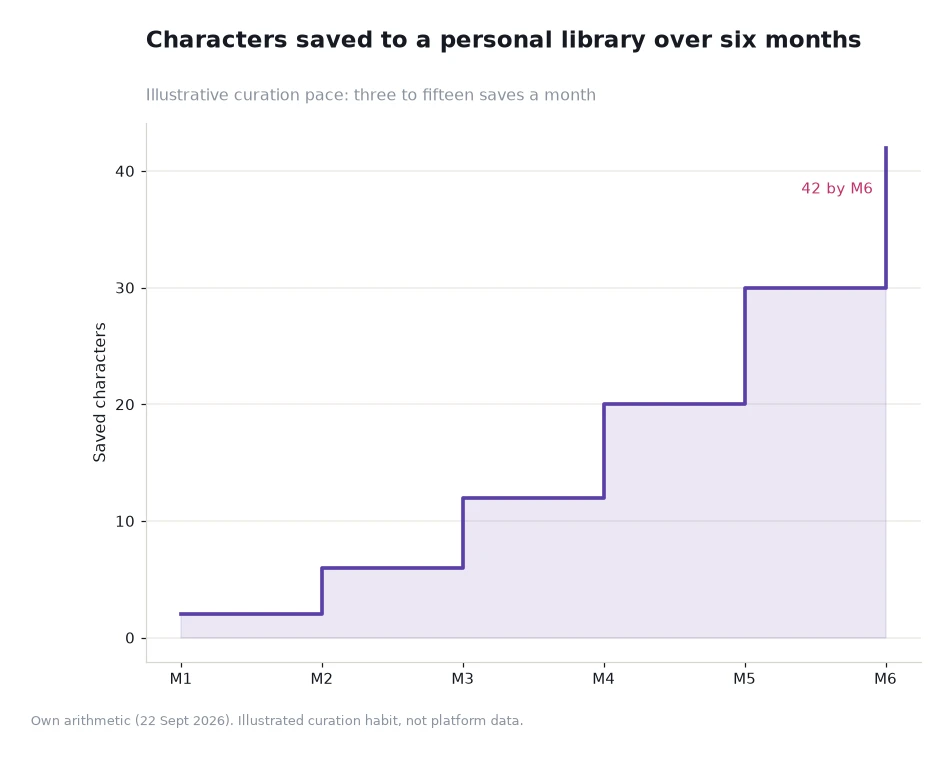
- Libraries accumulate quietly — 2, 6, 12, 20, 30 and 42 saves under one illustrative pace — and a library is itself a record worth reviewing.
What a chat log actually contains
Start by being precise about the record, because vagueness is what makes people careless. A session generates your messages, the character's replies, the timing of the exchange, and the saves and preferences that accumulate as you use the account. Nothing in that list is exotic, and all of it is text you or the platform produced on purpose.
Two of those categories deserve different treatment. The conversation itself is the part you control moment to moment and can simply choose not to fill with identifying detail. The accumulated layer — saves, a library, a shortlist of favourites — is a record of taste rather than of facts, and it grows whether or not you are paying attention.
The platform's own description of the environment is a private and secure environment with state-of-the-art encryption. Take that at face value and let it inform the habits below rather than replace them; no privacy design makes careless typing a good idea.
The minimisation rules that cover most cases
Six exclusions handle nearly every risk. No real name, no employer or job title specific enough to identify one, no address or neighbourhood, no contact handle of any kind, no financial detail, and no information about other people who never agreed to be in the conversation.
Two of those are worth spelling out. The contact handle matters because it is the one detail that can turn an anonymous session into an approachable one, and the information about other people matters because their details are not yours to spend.
Two more habits support the exclusions. Use a nickname for yourself if the character needs something to call you — any word will do, and it costs nothing. Then keep the session's fictional details fictional: a city you have never lived in, an occupation you have never had. Consistency is easier when nothing real needs protecting.
There is a reason this works better than warning yourself to be careful. A rule you have to remember in the middle of a conversation competes with the conversation itself, while a rule applied before it begins — nothing real, no names — has already done its work by the time the first message is sent.
| Detail | How it gets in | What it exposes | Habit |
|---|---|---|---|
| Real name | Introducing yourself out of habit | One search away from everything else | Pick a nickname on the first message |
| Work detail | Explaining your day | Employer and sometimes location | Keep the job generic or invented |
| Address or area | Descriptions of a routine | Where you live, loosely or precisely | Set the scene somewhere else entirely |
| Contact handle | Offering to continue elsewhere | A route into other accounts | Never type one, in any form |
| Financial detail | Small talk about plans | Material that should never be in a chat | Leave amounts and accounts out completely |
| Other people's detail | Naming family, friends or colleagues | Someone who did not consent to appear | Keep every named person fictional |
Worked example: the library as a record that grows
Saves are the part of the record people forget, because each one looks trivial on its own. Take an illustrative pace rather than a platform figure: two saves in month one, then four, six, eight, ten and twelve added afterwards. The running totals are 2, then 6, 12, 20, 30 and finally 42.
Forty-two saved characters after six months is a meaningful description of someone's taste. It is not a security incident, and it is worth noticing: a library that specific tells a story even when every individual conversation was careful about names and addresses.
The maintenance answer is a periodic review. At two minutes per entry, a full pass over 42 saves is about 84 minutes — a reasonable quarterly job — and the entries that go are usually the impulse saves rather than the ones that earned a second visit. Pruning also makes the library more useful, which is a pleasant side effect of treating it as a record.
What to do when something has already been typed
Prevention is the main tool, but the platform does provide routes when content is a problem. Each content page carries a report path, and the content removal policy explains what a report sets in motion. The complaints policy covers the escalation step when a first response is not the end of the matter.
Those routes are for content on the site. For your own habits the equivalent is a small audit: read back your last three sessions and count how many identifying details appear. Most readers find one or two, usually a workplace reference or a name, and one or two is exactly the number that a five-minute habit change fixes for good.
Crushon's site also makes the boundaries of the product clear, which helps with the same question. The compliance statement confirms that the content is AI-generated text depicting no real person, so there is no reason for a session to need anything real from you in the first place — the character has nothing factual to match it against.
The ai porn chat page makes the same point in its own words and settles the naming question while it is there, using Porn Chat AI and AI Porn Chat as two labels for one category. That matters to a reader keeping a log, because the features to check for are always the same three: customizable characters, privacy and discretion, and responses that recall earlier interactions.
Frequently asked questions
What single habit reduces the most risk?
Leaving identifiers out. A session that never contains a real name, employer, address or contact handle has nothing in its log that would matter if it were read.
Do saved characters count as personal data?
They are a record of taste rather than of facts, but they accumulate — 42 under one illustrative six-month curve — so a periodic review is worth the effort.
Where do I report a problem on the site itself?
Use the report path on the content page, or follow the removal and complaints policies, which document what happens after a report and how to escalate it.
Type as if the log will be read
A single test covers the whole approach: write each message as though you would be comfortable reading it back in a week. That standard needs no tools, no settings and no judgement about how any platform stores anything — and it is the habit that makes every other protection optional rather than essential.
Data and sources: the privacy wording, reporting routes and policies published on CrushOn.AI[1], read 22 Sept 2026. The six-month save curve, the two-minute review and the 84-minute audit are illustrative assumptions, not platform data. Intended for an adult audience aged 18 and older.