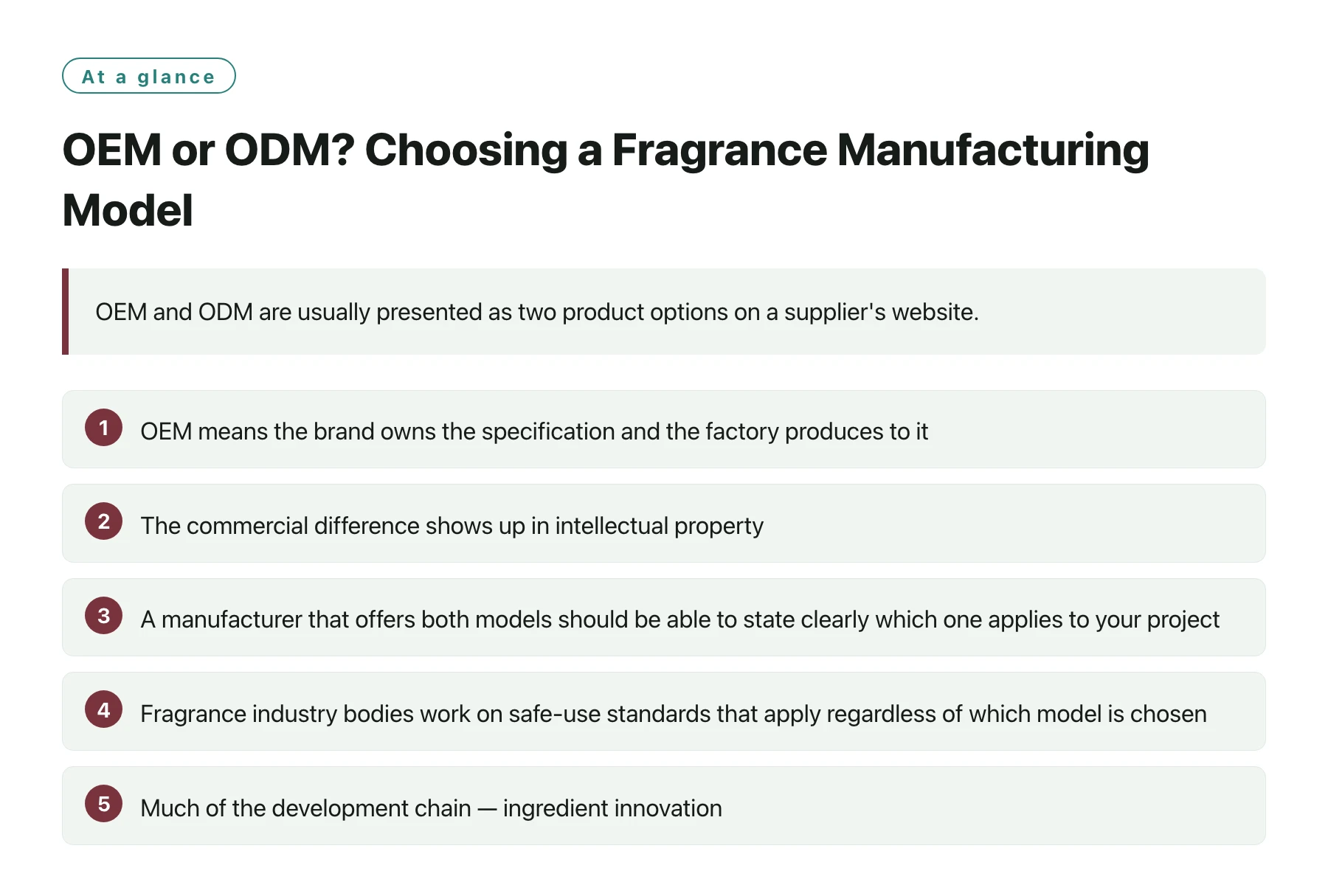
OEM and ODM are usually presented as two product options on a supplier's website. They are better understood as two answers to a single question: who carries the development risk? In an OEM arrangement the brand brings the specification and the factory executes it. In an ODM arrangement the factory proposes the formula, the format and often the packaging. Most real projects sit between the two, and pretending otherwise is how briefs and quotations end up describing different things.
Key takeaways
- OEM means the brand owns the specification and the factory produces to it; ODM means the factory develops the product and the brand selects from what is offered.
- The commercial difference shows up in intellectual property, minimum order quantities and how much of the formula a brand is allowed to take elsewhere.
- A manufacturer that offers both models should be able to state clearly which one applies to your project, in writing, before sampling starts.
- Fragrance industry bodies work on safe-use standards that apply regardless of which model is chosen, so the compliance route does not change with the contract type [1].
- Much of the development chain — ingredient innovation, sustainability work, creative perfumery — sits upstream of the factory floor, which is why the partner you choose also determines which materials you can access [2].
The confusion between OEM and ODM is not a language problem; it is a scoping problem. Ask five suppliers what they mean by ODM and you will get several different answers, ranging from a library of ready formulas to a full service that includes brand naming advice.
The distinction matters because it determines ownership. Whoever develops the formula usually controls how it can be used afterwards, whether it can be sold to another brand, and what happens to it when the relationship ends.
This article sets out the practical differences, the sequences that work for each model, and the questions that reveal which model a supplier is actually proposing.
Deciding which model fits your project
- Ask who owns the formula todayIf you already hold a formula or a detailed brief, you are buying production; if you hold only a market position, you are buying development.
- Check your internal development capacityOEM assumes you can evaluate and approve samples on your own terms. Without that capability, the ODM route is faster and less risky.
- Decide how exclusive the product must beA library formula may be sold to other brands in other markets. If the product has to be yours alone, that has to be negotiated and priced.
- Match the model to your order volumeDevelopment work has to be recovered somewhere. Small volumes usually suit existing formulas; custom development becomes economical at higher quantities.
- Agree the handover terms before samplingDecide in advance whether the formula documentation transfers to you, and under what conditions, if the relationship ends.
What each model actually gives you
The two arrangements produce different kinds of project. One is a production relationship with a specification at its centre; the other is a development relationship with a proposal at its centre.
Neither is inherently better. The mismatch happens when a brand expects development but has contracted for production, or the reverse.
OEM: control in exchange for responsibility
In a pure OEM arrangement the brand supplies the formula or an equivalent specification, and the manufacturer blends, fills, packs and documents it. The brand keeps the intellectual property and can usually move production to another factory with the same specification.
The cost of that control is that the brand also carries the development risk. If the formula does not perform, the factory has met its obligation by producing to specification.
ODM: speed in exchange for shared provenance
In an ODM arrangement the manufacturer brings the formula library, the development process and often the packaging concept, and the brand selects and refines. This compresses the timeline considerably, because the starting point is a product that already works.
The trade-off is provenance. Unless exclusivity is negotiated, the same formula may be available to other clients, and the documentation that describes it usually stays with the developer.
Comparing the two models on the things that matter later
| Dimension | OEM | ODM |
|---|---|---|
| Who develops the formula | The brand, or a perfumer working for the brand | The manufacturer's development team |
| Typical time to first sample | Longer, because development happens first | Shorter, because the starting point already exists |
| Who owns the documentation | Usually the brand | Usually the manufacturer, unless negotiated otherwise |
| Can the product move supplier | Normally yes, with the specification in hand | Only with the developer's agreement or a redevelopment |
| Where the money sits | Development paid for separately, production priced per unit | Development recovered within the unit price or a project fee |
| Best fit | Brands with a clear, owned product concept | Brands that need a market-ready product quickly |
The three rows that cause the most difficulty after launch are the middle ones, and they are all about ownership rather than cost. Price is settled in a quotation; ownership is settled in a contract, and it determines what you can do in three years' time when the product has succeeded and you want to change something.
How to evaluate a partner that offers both
Many manufacturers describe themselves as offering OEM and ODM together, which is credible for a full-service house and unhelpful as a decision aid. The useful step is to find out which model they are actually proposing for your brief.
Four questions separate the two quickly.
Questions that reveal the real model
Ask whether the formula proposed for you already exists in their library and, if so, which markets it has been sold into. Ask who signs the safety documentation, who holds the development records and what happens to the formula if you leave.
Ask too about exclusivity by category, territory and time. A formula can be exclusive in one market and shared in another, and that distinction is worth more than a general assurance of confidentiality.
Compliance does not change with the model
Whichever route you choose, the product still has to meet the same safety and labelling requirements. Fragrance industry bodies maintain safe-use standards that apply across the sector, and a manufacturer should be able to explain how its formulas are tracked against them [1].
That is a question about process rather than paperwork, so ask to see how the tracking is done rather than which certificate is framed on the wall.
Where the development actually happens
Large fragrance houses describe their work in terms of ingredient innovation and sustainability programmes alongside creative perfumery, which shows how much of the chain sits upstream of the factory floor [2]. A manufacturer's access to that upstream work shapes what it can propose to you, and it also shapes what the factory itself is: Xuelei, a Guangzhou house that describes 31 years of fragrance manufacturing, is built around development and production together rather than around one of the two.
Brands that need both development and production from one partner usually describe the scope as a single offer rather than two purchases, and that is how most Guangzhou houses present their OEM/ODM manufacturing services — one development route with production attached, rather than a menu of two unrelated products.
The most expensive misunderstanding in this area is not choosing the wrong model; it is discovering two years later that nobody agreed which model was in force. A project can run perfectly well under an informal mix of both, right up to the point where the brand wants to change factory, license the product, or sell into a market the manufacturer has already supplied. Put four lines in the contract: who owns the formula, whether it is exclusive and where, what documentation transfers on termination, and what notice period applies. Those four lines cost nothing at the start and decide everything at the end.
Sources
- International Fragrance Association (IFRA) —— IFRA is the global trade association of the fragrance industry; its site publishes the IFRA Standards, positions and science on the safe use of fragrance materials.
- dsm-firmenich —— A global fragrance, flavour and nutrition company; public information on perfumery, ingredients and sustainability programmes.
Frequently asked questions
What is the difference between OEM and ODM in fragrance?
In OEM the brand brings the formula or an equivalent specification and the factory produces to it, so the brand keeps ownership. In ODM the factory develops the formula and often the packaging concept, and the brand selects from what is offered, which is faster but usually means the documentation stays with the developer.
Which model is cheaper?
ODM usually costs less up front, because the development work is shared across a formula library and recovered in the unit price. OEM costs more to develop but gives the brand an asset it can move between suppliers. The cheaper option depends on whether you value speed or ownership more.
Can an ODM formula become exclusive to my brand?
Often yes, if it is negotiated and priced. Exclusivity is usually defined by category, territory and duration, and it may include a minimum volume commitment in exchange for the manufacturer withdrawing the formula from other clients in that market.
Do I need my own perfumer to work with an OEM factory?
Not necessarily, but you need someone who can evaluate samples and approve a specification on the brand's behalf. Without that capability the OEM route becomes difficult, and the ODM route is usually the more practical starting point.
What should I ask before signing with a manufacturer offering both?
Ask which model applies to your project, whether the proposed formula already exists in their library, who owns the development records, whether exclusivity applies by market, and what documentation transfers if the relationship ends. Get the answers in writing before sampling begins.